
In the previous module, we examined several reasons why real steam engines are inefficient. Heat can escape from the boiler, steam can leak from the engine, and friction can convert useful mechanical energy into unwanted heat.
These losses appear to be engineering problems. Better insulation can reduce heat loss, improved seals can reduce steam leaks, and improved bearings can reduce friction.
This naturally leads to an important question:
If all engineering imperfections could be eliminated, could a heat engine become 100% efficient?
To answer this question, we will examine a hypothetical engine that is free from all practical imperfections.
Hypothesis: A perfectly engineered heat engine can convert all heat supplied to it into useful work.
This hypothesis can be tested by analyzing a theoretical engine operating under ideal conditions.
Nicolas Léonard Sadi Carnot (1796–1832) proposed a theoretical heat engine designed to eliminate all practical inefficiencies. The engine operates reversibly and consists of four steps:
Because the cycle returns to its starting point, it is a closed cycle and all state functions must have a net change of zero.
| Leg | Process | \(q\) | \(w\) | \(\Delta U\) |
|---|---|---|---|---|
| I | Isothermal expansion at \(T_h\) | \(nRT_h\ln(V_2/V_1)\) | \(-nRT_h\ln(V_2/V_1)\) | 0 |
| II | Adiabatic expansion | 0 | \(n C_V(T_l-T_h)\) | \(n C_V(T_l-T_h)\) |
| III | Isothermal compression at \(T_l\) | \(nRT_l\ln(V_4/V_3)\) | \(-nRT_l\ln(V_4/V_3)\) | 0 |
| IV | Adiabatic compression | 0 | \(n C_V(T_h-T_l)\) | \(n C_V(T_h-T_l)\) |
Notice that the work contributions from the two adiabatic legs cancel when the complete cycle is considered.
For an adiabatic expansion of an ideal gas,
\[ TV^{R/C_V} = \text{constant} \]
Applying this relationship to the two adiabatic legs gives
\[ T_hV_2^{R/C_V} = T_lV_3^{R/C_V} \]
\[ T_lV_4^{R/C_V} = T_hV_1^{R/C_V} \]
Rearranging these expressions yields
\[ \left( \frac{V_3}{V_2} \right)^{R/C_V} = \frac{T_h}{T_l} \]
\[ \left( \frac{V_4}{V_1} \right)^{R/C_V} = \frac{T_h}{T_l} \]
Therefore,
\[ \boxed{ \frac{V_2}{V_1} = \frac{V_3}{V_4} } \]
This relationship is the crucial consequence of choosing adiabatic pathways. It allows all volume terms to disappear from the efficiency expression.
The efficiency of a heat engine is defined as
\[ \varepsilon = \frac{\text{work output}} {\text{heat supplied}} \]
From the table above, the total work performed by the engine is the sum of the work contributions from the four legs:
\[ w_{\mathrm{tot}} = -nRT_h\ln\left(\frac{V_2}{V_1}\right) + C_V(T_l-T_h) - nRT_l\ln\left(\frac{V_4}{V_3}\right) + C_V(T_h-T_l) \]
The adiabatic terms cancel:
\[ w_{\mathrm{tot}} = -nRT_h\ln\left(\frac{V_2}{V_1}\right) - nRT_l\ln\left(\frac{V_4}{V_3}\right) \]
The heat supplied occurs only during the isothermal expansion at \(T_h\):
\[ q_h = nRT_h \ln\left(\frac{V_2}{V_1}\right) \]
Therefore,
\[ \varepsilon = \frac{ -nRT_h\ln\left(\frac{V_2}{V_1}\right) - nRT_l\ln\left(\frac{V_4}{V_3}\right) } { nRT_h\ln\left(\frac{V_2}{V_1}\right) } \]
Factoring out \(nR\), and inverting the volumes in the first term on top to get rid of the minus sign:
\[ \varepsilon = \frac{T_h\ln\left(\frac{V_2}{V_1}\right) - T_l\ln\left(\frac{V_3}{V_4}\right)}{T_h\ln\left(\frac{V_2}{V_1}\right)} \]
At first glance, this expression appears to depend on four volumes as well as the two temperatures.
However, the adiabatic legs impose the relationship
\[ \frac{V_2}{V_1} = \frac{V_3}{V_4} \]
and therefore
\[ \varepsilon = \frac{T_h\ln\left(\frac{V_3}{V_4}\right) - T_l\ln\left(\frac{V_3}{V_4}\right)}{T_h\ln\left(\frac{V_3}{V_4}\right)} \]
The logarithmic terms cancel, leaving
\[ \boxed{ \varepsilon = \frac{T_h - T_l}{T_h} = 1 - \frac{T_l}{T_h} } \]
Remarkably, the maximum efficiency depends only on the temperatures of the hot and cold reservoirs. All information about the working substance and the volumes disappears from the final result.
The only way to obtain
\[ \varepsilon = 1 \]
would be to require
\[ T_l = 0\ \mathrm{K} \]
a temperature that cannot actually be reached, at least according to that pesky Third Law of Thermodynamics!
As it turns out, Carnot's efficiency relationship can be applied to any closed-loop (initial and final states are the same) process. This is because any such loop can be expressed as a sum of infinitesimally small Carnot loops!
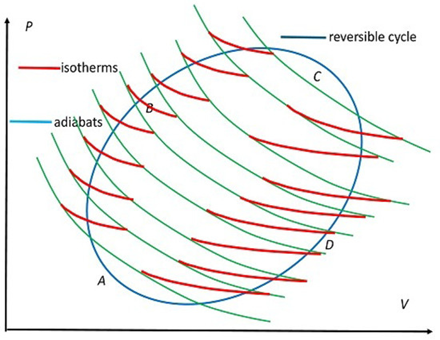
Source: "Carnot Theorem Revisited: A Critical Perspective", P. D. Gujrati, Entropy 2025, 27(4), 346; https://doi.org/10.3390/e27040346
Consider \(1.00\ \mathrm{mol}\) of a monatomic ideal gas initially at \(298\ \mathrm{K}\) and \(24.4\ \mathrm{L}\). The gas undergoes the following reversible cycle:
For a monatomic ideal gas, \(C_V=\frac{3}{2}R\). The lower temperature is found from the adiabatic relationship:
\[ T_l = T_h\left(\frac{V_2}{V_3}\right)^{R/C_V} =298\ K\left(\frac{48.8\ L}{97.6\ L}\right)^{2/3} =188\ \mathrm{K} \]
| Leg | Process | \(\Delta U\) | \(q\) | \(w\) |
|---|---|---|---|---|
| I | Isothermal expansion at \(298\ \mathrm{K}\) | \(0\) | \(+1.72\ \mathrm{kJ}\) | \(-1.72\ \mathrm{kJ}\) |
| II | Adiabatic expansion | \(-1.38\ \mathrm{kJ}\) | \(0\) | \(-1.38\ \mathrm{kJ}\) |
| III | Isothermal compression at \(188\ \mathrm{K}\) | \(0\) | \(-1.08\ \mathrm{kJ}\) | \(+1.08\ \mathrm{kJ}\) |
| IV | Adiabatic compression | \(+1.38\ \mathrm{kJ}\) | \(0\) | \(+1.38\ \mathrm{kJ}\) |
| Total | \(0\) | \(+0.64\ \mathrm{kJ}\) | \(-0.64\ \mathrm{kJ}\) | |
As expected for a complete cycle,
\[ \sum \Delta U = 0 \]
because internal energy is a state function.
The work delivered by the engine is the negative of the total work on the system:
\[ |w_{\mathrm{tot}}| = 0.64\ \mathrm{kJ} \]
The heat supplied during the high-temperature isothermal expansion is
\[ q_h = 1.72\ \mathrm{kJ} \]
Therefore, the efficiency is
\[ \varepsilon = \frac{|w_{\mathrm{tot}}|}{q_h} = \frac{0.64\ kJ}{1.72\ kJ} = 0.37 \]
This matches the Carnot efficiency:
\[ \frac{T_h-T_l}{T_h} = \frac{298\ K - 188\ K}{298\ K} = 0.37 \]
Physical interpretation: Even for a perfectly reversible Carnot engine, only part of the heat absorbed at the high temperature is converted into work. The rest is rejected during the low-temperature isothermal compression.
Big picture: The Carnot cycle demonstrates that there is a fundamental limit to the efficiency of any heat engine. Even a perfectly engineered engine cannot convert all heat into work. This remarkable result suggests that nature imposes restrictions beyond those contained in the First Law of Thermodynamics and motivates the introduction of a new thermodynamic quantity: entropy.