
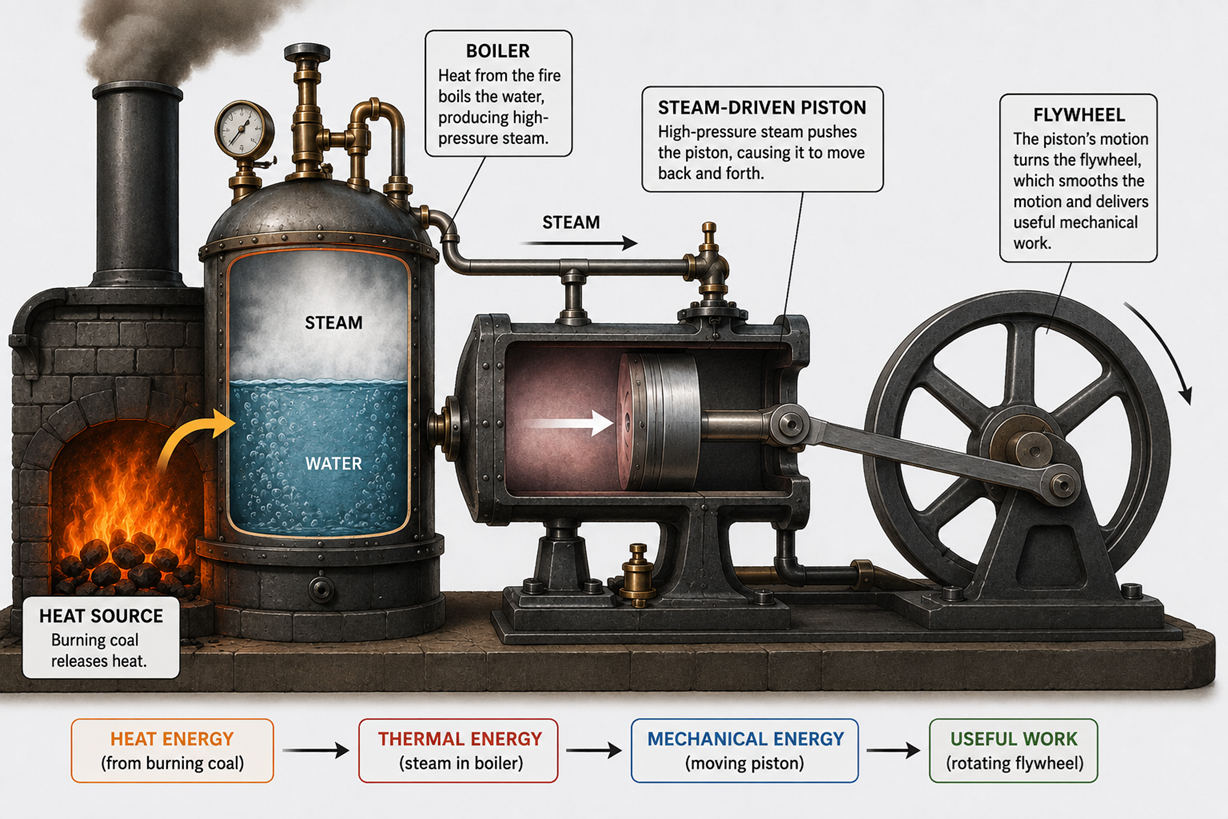
A Simple Steme Engine. (Image generated by ChatGPT 5.5.)
A heat engine is a device that converts energy supplied as heat into useful mechanical work. Steam engines, automobile engines, jet engines, and electrical power plants all operate on this basic principle.
Consider a simple steam engine. Fuel is burned beneath a boiler, causing water to absorb energy and vaporize. The resulting high-pressure steam is directed into a cylinder where it pushes against a piston.
As the piston moves, the steam expands and performs pressure-volume work. Mechanical linkages connect the piston to a flywheel, converting the reciprocating motion of the piston into rotational motion that can be used to perform useful tasks.
In this way, thermal energy supplied to the boiler is transformed into mechanical work.
Let us begin with a very optimistic hypothesis. Suppose that every joule of heat supplied to the boiler ultimately emerges as useful mechanical work.
Heat Input → Engine → Work Output
In this idealized picture,
\[ q_h = -w \]
If \(100\ \mathrm{J}\) of heat were supplied to the boiler, then \(100\ \mathrm{J}\) of useful work would be produced.
The efficiency would therefore be
\[ \varepsilon = \frac{\text{work output}} {\text{heat input}} = 1 \]
\[ \boxed{\varepsilon = 100\%} \]
Such an engine would be extraordinarily useful because no energy would be wasted.
Actual steam engines do not behave this way. Several processes reduce the amount of useful work that can be extracted from the heat supplied to the boiler.
As a result, a more realistic picture of a steam engine is
Heat Input → Engine → Work Output
↘ Lost Heat
The efficiency is therefore less than 100%.
At first glance, these losses appear to be engineering problems.
Better insulation could reduce heat loss. Improved seals could reduce steam leaks. Better bearings and lubrication could reduce friction.
This naturally leads to an important question:
If all of these losses could be eliminated, could a heat engine become 100% efficient?
To answer this question, we need to examine a hypothetical engine that is free from all practical imperfections. This thought experiment, proposed by Sadi Carnot, leads directly to one of the most important conclusions of thermodynamics.
Big picture: Real engines are inefficient because of heat losses, leaks, and friction. But are these the only reasons that engines fail to reach 100% efficiency? The Carnot cycle allows us to explore whether nature itself imposes a more fundamental limit.
Suppose burning coal releases \(1000\ \mathrm{J}\) of energy as heat. The engine loses energy at three stages:
Calculate the useful work delivered by the engine.
\[ q_{\mathrm{boiler}} = (1000\ \mathrm{J})(1-0.200) = 800\ \mathrm{J} \]
\[ q_{\mathrm{steam}} = (800\ \mathrm{J})(1-0.100) = 720\ \mathrm{J} \]
\[ |w| = (720\ \mathrm{J})(1-0.150) = 612\ \mathrm{J} \]
Therefore, the engine delivers
\[ \boxed{|w|=612\ \mathrm{J}} \]
The overall efficiency is
\[ \varepsilon = \frac{612\ \mathrm{J}} {1000\ \mathrm{J}} = 0.612 = 61.2\% \]
Physical interpretation: Each loss reduces the energy available to the next step. Even though the listed losses are \(20.0\%\), \(10.0\%\), and \(15.0\%\), the total loss is not simply \(45.0\%\), because each percentage applies to the energy remaining after the previous step.
Big picture: Heat engines transform thermal energy into useful mechanical work. Real engines lose energy through heat loss, leaks, and friction, reducing their efficiency. But even if all of these engineering imperfections could be eliminated, an important question remains: can a heat engine ever be 100% efficient?