
A phase diagram tells us which phases are present at a given temperature, pressure, and composition. However, it does not immediately tell us how much of each phase is present.
Consider a binary mixture of two volatile liquids, A and B. Suppose the overall composition and temperature place the system inside a two-phase liquid-vapor region.
At these conditions, the system separates into:
The compositions of the two phases are determined by the endpoints of the tie line that passes through the overall composition.
The remaining question is:
How much liquid and how much vapor are present?
The answer is provided by the lever rule.
Consider the simplified liquid-vapor phase diagram shown below.
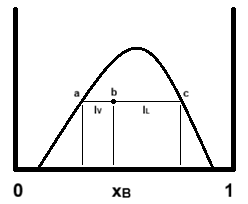
Let
\[ x_L \]denote the composition of the liquid phase,
\[ x_V \]the composition of the vapor phase, and
\[ x_0 \]the overall composition of the system.
The distances along the tie line are
\[ l_L=x_0-x_L \]and
\[ l_V=x_V-x_0 \]The amounts of liquid and vapor are inversely proportional to these distances:
\[ \frac{n_L}{n_V} = \frac{l_V}{l_L} \]This relationship is called the lever rule.
The rule resembles a balance beam. A phase located farther from the overall composition must be present in a smaller amount, while a phase located closer to the overall composition must be present in a larger amount.
The overall composition of the system must be a weighted average of the compositions of the phases present.
If most of the material is liquid, the overall composition must lie closer to the liquid-phase composition. If most of the material is vapor, the overall composition must lie closer to the vapor-phase composition.
The lever rule is simply a mathematical statement of this mass-balance requirement.
For example, if the overall composition lies very close to the liquid boundary, only a small amount of vapor is present. Conversely, if the overall composition lies close to the vapor boundary, only a small amount of liquid is present.
In a liquid-vapor equilibrium, the vapor phase is usually richer in the more volatile component than the liquid phase. The lever rule therefore allows us to determine not only the composition of each phase, but also the relative amounts of liquid and vapor present.
This information is essential in the analysis of distillation processes, where repeated vaporization and condensation are used to separate mixtures based on differences in volatility.
Big picture: The tie-line endpoints determine the compositions of the phases present, while the lever rule determines their relative amounts. Together, these tools allow phase diagrams to be used as quantitative descriptions of phase equilibrium rather than merely qualitative maps.
| Question 1 |
|---|
|
A binary liquid-vapor system is represented by a point inside a two-phase region of a phase
diagram. What information is provided by the endpoints of the tie line passing through that
point?
A. The amounts of liquid and vapor present. B. The compositions of the liquid and vapor phases. C. The boiling points of the pure components. D. The total pressure of the system. |
Show AnswerAnswer: BThe endpoints of a tie line indicate the compositions of the two phases that coexist at equilibrium. In a liquid-vapor system, one endpoint corresponds to the liquid composition and the other corresponds to the vapor composition. |
| Question 2 |
|---|
|
In a two-phase region, the overall composition lies very close to the liquid-phase boundary.
What does the lever rule predict?
A. Mostly liquid and a small amount of vapor. B. Mostly vapor and a small amount of liquid. C. Equal amounts of liquid and vapor. D. The amounts cannot be determined. |
Show AnswerAnswer: AThe overall composition is a weighted average of the phase compositions. If the overall composition lies close to the liquid boundary, the liquid phase must be present in a much larger amount than the vapor phase. This is exactly what the lever rule quantifies. |
| Question 3 |
|---|
|
Why is the relationship called the lever rule?
A. It was discovered by a mechanical engineer. B. It only applies to systems under pressure. C. The phase amounts behave like masses balanced on a lever, with distances measured from the overall composition. D. It is derived from the ideal gas law. |
Show AnswerAnswer: CThe geometry of the tie line resembles a balance beam or lever. The amount of each phase is inversely proportional to its distance from the overall composition, just as masses on a lever are related to their distances from the pivot point. This analogy provides an easy way to remember the lever rule: \[ \frac{n_\alpha}{n_\beta} = \frac{l_\beta}{l_\alpha} \] |
Big picture: The tie line tells us the composition of each phase present at equilibrium, while the lever rule tells us how much of each phase is present. Together, these tools transform a phase diagram from a qualitative map into a quantitative description of phase equilibrium.